The first owner of our house was N.F. Merck, either Noble Frank or Frank Noble. In 1927, he and his wife Marion lived with Horace Merck in the Springfield neighborhood, in Apt. 5 of a building on Main St. next to N.F.'s pharmacy, "Merck Drug Co." My mom, a nurse, became very excited when I told her about Frank, or Noble, but I don't think there is a connection to Merck & Co., (of Vioxx fame) which patented its name a decade before "Merck Drug Co." opened shop in Springfield. Merck owned this house for 5 years. His wife became a saleswoman for a drugstore chain, Lane Drug Co., at neighborhood store #76. It's possible that the Mercks left Springfield so Marion's commute would be shorter, while N.F. probably drove across town. (Maybe he parked his car in the garage footprint!) Merck Drug Co. moved downtown in the 1930s to what appears to be the block of buildings torn down two years ago to build the new main library and contemporary art museum, by Hemming Plaza. Interestingly, the 1927 directory listing for Merck Drug Co. advertised their slogan as "Drugs with a Reputation", which was then the slogan for Walgreen's Drugstores. I found a photo from 1947, four years before the drugstore ended, and the sign does say Merck Drug Co. All of Mr. Merck's previous residences are now parking lots, and in the 1940's he was just a post office box.
The house has since had many residents:
1934 - Vasco and Ethel Geiger, Vasco was a clerk.
1938-1955 - John H. Webb and wife Miriam. John started in lumber, and moved into poultry. He appears to have had the longest ownership.
1956 -1967 - A series of renters. The Webbs no longer live in Jacksonville. There is a different renter in the house every year for at least 12 years, many in the Navy, one a florist, one a stevedore, one who worked for local grocer Winn Dixie.
1968-1991 - The library closed before I could continue in the directories and indexes. Jason says if I keep this up, I'll open a portal to the underworld.
1992-2005 - Agnes Hogan. I'm not sure how long Agnes actually lived here; by the incoming junk mail there have been many renters in the past few years but Ms. Hogan's name has been on the property taxes as owner AND resident. Probably not legally. The house was purchased from her trust by Mr. Hazouri, the flipper. There is a small handful of infamous Hazouris in Jacksonville, one a mayor in the early 90s. I remember my mom snagged him in a parking lot after his speech at a US Navy event to shake hands and voice an opinion. His keepers looked nervous. My hair was unclean and I was skipping school. But I digress.
The first owner next door, in 1929, was JC Rawlins, a cashier for Cudahy Packaging Co.
Also, in the 1800s this southern part of the neighborhood was a cotton plantation.
There are still many more leads to follow, especially with the Merck Drug Store. Was he a black sheep in the American Merck family to be living in this small house, barely incorporated into the city, or a distant relative, or was he unrelated? It's all very interesting, and I haven't dug into any city-owned paperwork like tax or business records yet.


Friday night in the attic
I feel guilty for kicking J out of the bedroom closet (I have a serious pajama collection). I hope I made up for it last night with this temporary light for his closet. Despite him being the primary wage earner, his closet is half the size of the other, and he shares it with holiday decorations and the attic opening. Poor J. Even worse, until we move the opening to the kitchen, everything in his closet needs to be portable for the ladder access.
I was so eager to surprise him with this light by the time he came back from rehearsal last night, I didn't even paint it. The light was $7 on clearance from Lowes, its main benefit being a sturdy wall-mounted arm. I wired it to an in-line switch and plug, which plugs into an extension cord (bad, I know). The extension cord goes into the attic, where the attic light is hard-wired on its own circuit right above the opening. There I screwed in a socket with an outlet for the extension cord. This way, the light and backer plate are completely unpluggable and removable so we can take down boxes and stick a ladder in the ladder-sized closet. This cost the same as those dim battery powered lights from Target. Still, this is a very low-wattage bulb, as lights in tiny spaces make me edgy. We'll get him a permanent, cooler ceiling light when we close this attic opening.
While I was in the attic, I poked around a bit. There are four stacks of puzzle boxes from the 80's and 90's. Lots of Charles Wysocki, and several mystery puzzles, like Murder She Wrote. I also found a Sears receipt from November 1992 for Reebok shoes, purchased by the previous owner, and a punched-brass Christmas ornament of a teddy bear. Then I sat on a joist and just looked around. It was so nice up there on a cool rainy night. Usually I come down the ladder unable to bend my knees because the pants are so thoroughly wet with sweat. But last night it was nice enough to make me want to finish the space! Hot times are coming soon, though, and even nights up there will be 100 degrees. Who needs ventilation? We do! Last week I looked at some local eaves and saw that between every other rafter, two 1 1/2" holes had been drilled about 6" apart, and backed with screen. This seems more economical than drilling holes and popping in those plastic cup vents, although those have larger holes=more airflow.

I was so eager to surprise him with this light by the time he came back from rehearsal last night, I didn't even paint it. The light was $7 on clearance from Lowes, its main benefit being a sturdy wall-mounted arm. I wired it to an in-line switch and plug, which plugs into an extension cord (bad, I know). The extension cord goes into the attic, where the attic light is hard-wired on its own circuit right above the opening. There I screwed in a socket with an outlet for the extension cord. This way, the light and backer plate are completely unpluggable and removable so we can take down boxes and stick a ladder in the ladder-sized closet.
 This cost the same as those dim battery powered lights from Target. Still, this is a very low-wattage bulb, as lights in tiny spaces make me edgy. We'll get him a permanent, cooler ceiling light when we close this attic opening.
While I was in the attic, I poked around a bit. There are four stacks of puzzle boxes from the 80's and 90's. Lots of Charles Wysocki, and several mystery puzzles, like Murder She Wrote. I also found a Sears receipt from November 1992 for Reebok shoes, purchased by the previous owner, and a punched-brass Christmas ornament of a teddy bear. Then I sat on a joist and just looked around. It was so nice up there on a cool rainy night. Usually I come down the ladder unable to bend my knees because the pants are so thoroughly wet with sweat. But last night it was nice enough to make me want to finish the space! Hot times are coming soon, though, and even nights up there will be 100 degrees. Who needs ventilation? We do! Last week I looked at some local eaves and saw that between every other rafter, two 1 1/2" holes had been drilled about 6" apart, and backed with screen. This seems more economical than drilling holes and popping in those plastic cup vents, although those have larger holes=more airflow.

Wiring your own subway
I have often wondered, as I race around the footstool and couch and basket of newspapers and floor lamp at the farthest corner of the house to answer the phone, why is the phone line installed on the fireplace? Is it so when the fireplace catches fire, the fire can call for help? Was this someone's attempt at wiring the intelligent house of the future? After researching on TOH's website, and here, I decided, I've got wire cutters, I'll go under the house and re-wire. It took the usual 6-7 project hours (never feels like a quality job unless it takes at least 6-7 hours) and two trips to Lowes. Now I have a fax machine in the office rather than on the fireplace bookshelf, and a corded phone on the kitchen wall so I can sit there, like in olden times, and talk on the phone. I made sure to call my mom to tell her what I had done.
Sometime in the past, when a cable-co. person was installing a line for the office, they guessed at the location of the wall and drilled through the living room floor instead. Rather than go back under the house and re-do the hole (oh that crawl space is nasty!) they continued to feed the cable up through the floor and drilled another hole through the wall and into the office. I removed it and paired it up with the phone cable in a correct new hole between studs and then attached a fancy new coaxial/phone line plate to the office wall. It looks like we're high-tech! And I used to be afraid of wiring. I'll use the remaining wall hole for another line in the living room, as it's a central location.
To add these outlets, I mapped out all our wiring. We have 7 phone outlets installed (only two working) and also two boxes with separate electric supplies. The house is only 1000 sq feet. You can stand at one outlet and spit to another. So why did the existing kitchen phone alone need a second phone line? Why pay monthly for another phone line when so many things around here needed fixing? Like, you know, attaching the kitchen sink drain to a drain pipe.
Phone wiring diagram, all non-right angles are the cables, including the one which circles around the eaves (see, no one else wants to go under the house either):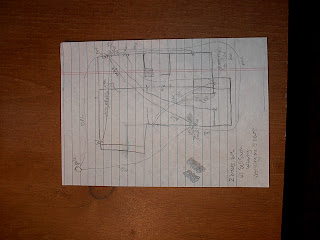
Then I decided to map our electric system in the attic, too, for kicks:
 It's like a badly designed version of London Underground. Each color is a different circuit. The red is fabric from 1928, as is part of the blue. There are a few minor things that need to be done electric-wise, like three-way switches. Some people are afraid of sewing machines, I'm afraid of electricity. But I'm getting better.
Sometime in the past, when a cable-co. person was installing a line for the office, they guessed at the location of the wall and drilled through the living room floor instead. Rather than go back under the house and re-do the hole (oh that crawl space is nasty!) they continued to feed the cable up through the floor and drilled another hole through the wall and into the office. I removed it and paired it up with the phone cable in a correct new hole between studs and then attached a fancy new coaxial/phone line plate to the office wall. It looks like we're high-tech! And I used to be afraid of wiring. I'll use the remaining wall hole for another line in the living room, as it's a central location.
To add these outlets, I mapped out all our wiring. We have 7 phone outlets installed (only two working) and also two boxes with separate electric supplies. The house is only 1000 sq feet. You can stand at one outlet and spit to another. So why did the existing kitchen phone alone need a second phone line? Why pay monthly for another phone line when so many things around here needed fixing? Like, you know, attaching the kitchen sink drain to a drain pipe.
Phone wiring diagram, all non-right angles are the cables, including the one which circles around the eaves (see, no one else wants to go under the house either):

Then I decided to map our electric system in the attic, too, for kicks:
 It's like a badly designed version of London Underground. Each color is a different circuit. The red is fabric from 1928, as is part of the blue. There are a few minor things that need to be done electric-wise, like three-way switches. Some people are afraid of sewing machines, I'm afraid of electricity. But I'm getting better.
Free undies!
This morning we went out to mow and fertilize. In the ferns, just where our house meets the neighbor's, was an expensive new but probably used pair of men's white underwear. Our neighbor was locked out of his house at 4AM, probably a little wasted too, what with the window screens down and him yelling, but there didn't seem to be a good explanation for the nicely laid-out lingerie. By the time I realized what fun it would be to take a picture of the renter randomness, the underwear was gone.
I know the deck doesn't look so 1920's. Some may say the railing appears out of scale or too busy. Sometimes I like it, sometimes not. If only I could have Martha Stewart 1928, on call to answer my questions about lights and cabinetry and plants and dinner. I do tons of period research, but I hardly ever look at it. The research is more fun than planning the project. And I'm encouraged to be an impulsive shopper, although I move like a snail when making decisions.
However, the pine will only last 15 years in our climate (ooh, even less if a hurricane comes along! not that I'm asking), and then something else will go up. Besides, the deck rail is good practice for the eventual front porch railing, which will have wider, flat boards, closer together.
I have good pictures of a pergola, for the deck extension, from 1928. I will follow the picture this time. That helps me feel I'm making progress toward restoration rather than just adding on. And because our brick was too soft to attach ledger boards to, the only alteration done to the house was to knock out the top two steps, which were cracking up anyway. My theory on restoration is to only do things which won't cause future loss (i.e. cracks in the foundation) and can be reversed. Pergola:
 Wow, I want a house for $696. Elmhurst #3 (top right) is most similar to our layout. Looking at this now, maybe beefing up the posts (hee says the vegetarian) will help my deck, and perhaps by adding more balusters? And window boxes with cascading vegetation. Totally. Or what if this car was parked in front of it?
I know the deck doesn't look so 1920's. Some may say the railing appears out of scale or too busy. Sometimes I like it, sometimes not. If only I could have Martha Stewart 1928, on call to answer my questions about lights and cabinetry and plants and dinner. I do tons of period research, but I hardly ever look at it. The research is more fun than planning the project. And I'm encouraged to be an impulsive shopper, although I move like a snail when making decisions.
However, the pine will only last 15 years in our climate (ooh, even less if a hurricane comes along! not that I'm asking), and then something else will go up. Besides, the deck rail is good practice for the eventual front porch railing, which will have wider, flat boards, closer together.
I have good pictures of a pergola, for the deck extension, from 1928. I will follow the picture this time. That helps me feel I'm making progress toward restoration rather than just adding on. And because our brick was too soft to attach ledger boards to, the only alteration done to the house was to knock out the top two steps, which were cracking up anyway. My theory on restoration is to only do things which won't cause future loss (i.e. cracks in the foundation) and can be reversed. Pergola:
Wow, I want a house for $696. Elmhurst #3 (top right) is most similar to our layout. Looking at this now, maybe beefing up the posts (hee says the vegetarian) will help my deck, and perhaps by adding more balusters? And window boxes with cascading vegetation. Totally. Or what if this car was parked in front of it? 
Subscribe to:
Posts (Atom)