Down in the Catacombs


J and I today went under the house to clear out the pile of bricks left from the 70's house-lifting. We aimed for the useful whole ones. Many of them still had the mortar on them from when they were dislodged from the foundation, which, kinda scary because it's the same mortar on many of the foundation bricks, just brushed off in chunks. I don't feel compelled to leave them under the house so the foundation can be reconstructed; I've seen many older houses in Jacksonville on piers 6-8 ft apart. We took them outside and put them in the garden paths.

While we were down there (it's only my second time, it's not my favorite place) we took photos of the floors underneath the bath and kitchen. I was suprised to see the bath subfloor much worse than the kitchen; it looks like the original checkerboard mosaic tiles were on a bed of steel mesh that held moisture well and thoroughly rotted the floor around the tub. And I was right, the subfloor is completely gone under a section of the tub. The WDO inspector had shown us photos but their geography was hard to understand. The original tile floor is under the tile, subfloor 2 and the vinyl! Maybe it's salvagable! Or not! It's neat though!

Under the bathtub corner:
The meshed area is the original floor under the bathtub; the white speckly thing center is the corner of the tub.
Very thankful there's not much damage to the joists here, and some stuff was replaced by the flipper.


Selections from the pile of tile under the bathtub. The whitish tile is sky blue, and the mosaic is less gross than it looks.
Under the kitchen we found vinyl and linoleum scraps and this uncracked glass. We also found lots of vintagy bottles, toy dumptruck parts, a small plastic horse, a fishing pole, green plastic christmas tree stand, old bicycle basket, a bucket of joint compound that unfortunately was not a Bucket of Gold, 70's Busch beer cans, and Pepsi bottles. When I was sifting through the bath rubble, the world's tiniest frog jumped out. I thought it was a baby cricket. It was 1/8" square when sitting, a dark brown color.

A post about brick posts

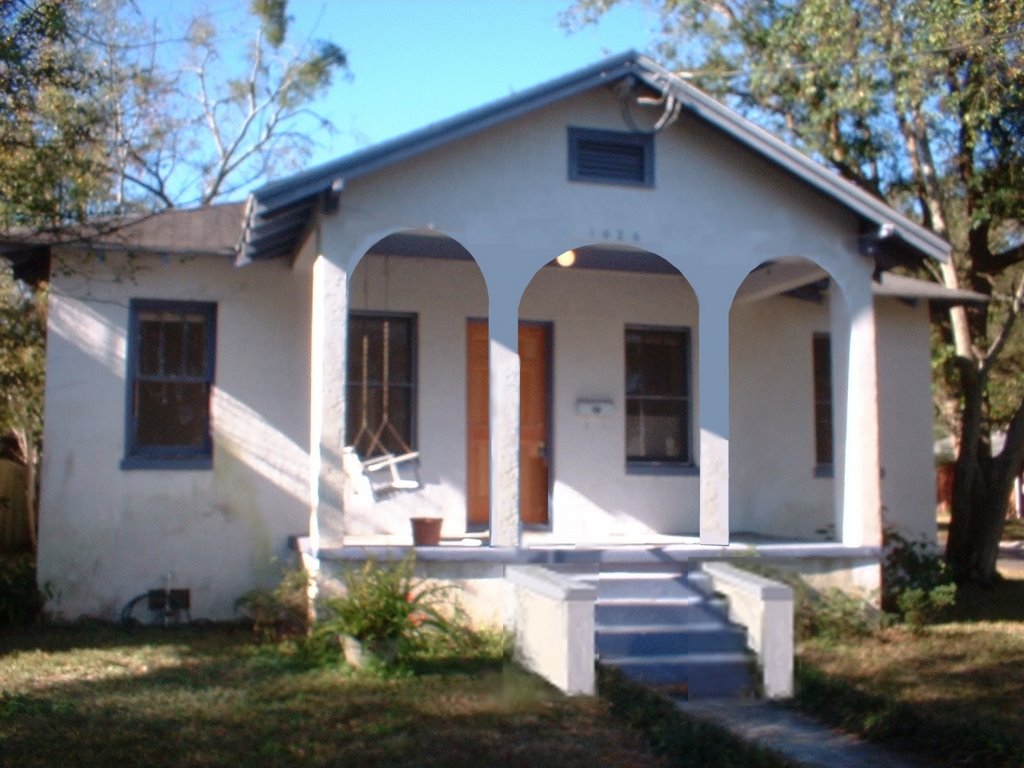
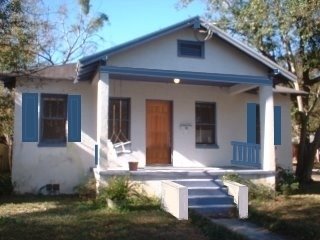
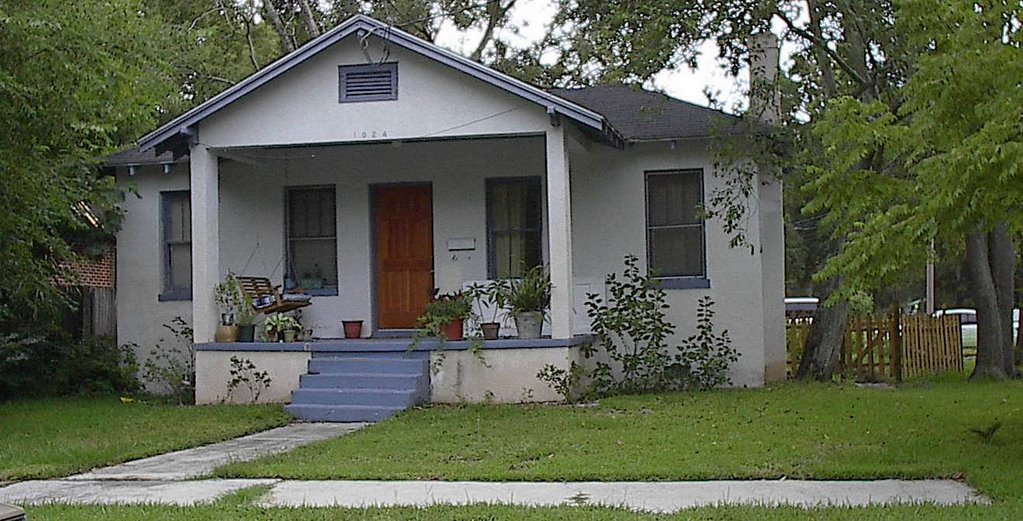
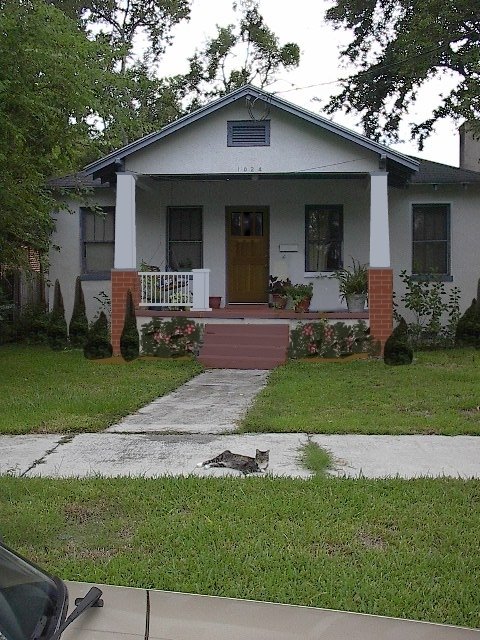
Maybe we'll do a cool broken-tile mosaic on the front steps, and of course the rail would be continued all the way around the porch. This rendering happened because last night I wondered if the brick was still inside the columns. Nope, they're plywood. So I've worked out how to make them reappear with wood columns above, something to dress up the house front. I’m also thinking of putting trim around the windows since the original window trim is hidden under the fake stucco. This will make the windows look less cavernous and make us feel less Flinstones. The sidewalk is a great width but stick-straight and covered with some sort of whitening cement which is wearing away, especially when you pour vinegar on it.

That's Fluffy, a volunteer cat. She's been hanging out here for weeks but actually lives two houses down. She's very affectionate but doesn't like Ralph. There are two other volunteer cats as well.

Follow the cypress-mulch path

Our Paint program does helpful house things.


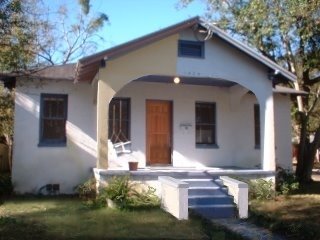
We're deciding paint colors and whether we want to change the porch shape. We think there used to be arches because houses in the neighborhood with the same layout and brick issues, like the house next door, have two arches on the front of their porches and a side entrance. The front view of their arches are formed with the butt-end of the bricks, and the space from the porch corner to the bottom outside edge of the brick-end arch is exactly the front width of our columns, if that makes any sense. Our porch may also have had a side entrance.

One thing I can't figure out is why our house is at least a foot higher from the ground than its brothers and sisters. Yes, and why we have yard where everybody else has a little room next to the back door! Maybe they ran out of brick. It would have been a kick-ass place to keep the cat box.


I built a compost bin and dug a path to it yesterday. Anywhere we put the bin it would be easily smelled by neighbors so it's by the house.

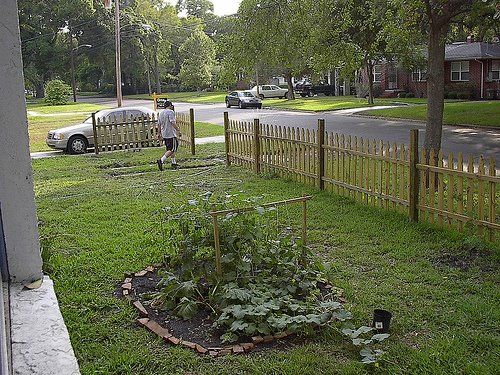
We're filling the path with $1.70 concrete slabs from Lowe's, embedded in shredded mulch. This seems more removeable and less messy than chipped rock, and simpler than continuing our brick path. Although, we seem to be having a boric-acid-proof carpenter ant problem... guess they'd live under brick too, though. Florida is the perfect climate for those guys. The vegetable bed's getting elevated and duplicated on the side by the camera.


The end of the yellow brick road (it's actually a peachy terracotta)

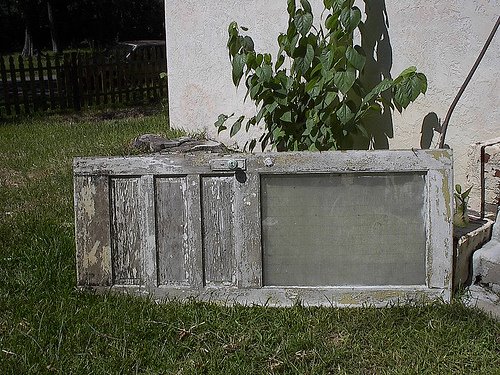
door from a dumpster!

This week we dug a path from the side gate past the vegetable garden; the St. Aug grass was mostly dead from chinch bugs anyway. Something mysterious had been sucking the life from the grass and one day I saw a whole bunch of bugs sunning themselves on a wall, trying to tan, I guess. I thought they were odd and harmless and occasionally killed them with homemade insect soap, but today I saw the Garden Q&A in the paper and have taken steps. At least the steps to the hardware store; the poison is sitting on the kitchen counter next to the sprayer. Job for tomorrow.

J cleared out our wood resource pile in the back corner after I discovered carpenter ants in the logs this week. I'd hoped to use them to build an elevated vegetable bed but know now that's foolish. Last week I found a colony of them living in the roots of the fig tree I got from the Jacksonville Fair last year.

Mom and I went dumpster-diving in Springfield, an area of Jacksonville that's undergoing significant rehabbing (see restoration on 7th blog). Most of the stuff that comes from these beautiful old houses isn't fit to be reused, often tagged or peed on or held together with chickenwire and roofing nails, or the original interior parts are long gone and patched over with ancient vinyl flooring and random boards. But we found some exterior doors, the most sturdy one we put in the van. I scraped it, filled the nail holes and sanded & primed one side. The knobs are solid copper. If I can bring myself to do it, I'll knock out the half-door glass pane and install screen instead. Either way, it's going in place of a screen door on the back of the house, to cover up our ugly new steel door from PO.

House Tour

The house is set up in an H, with public places to the right of the front door, and two bedrooms and bathroom on the left through a privacy door and hallway. The French doors between the living room and dining room were removed when those rooms took on wallboard to cover the wall cracks from the sinking chimney in the 70s. The only evidence of the doors is the metal plate in the floor meant to catch the sliding door bolt. It looks like a smiley face.
The house is a block from the Miami-Washington D.C. train tracks used by Amtrak, the I-95 of the East Coast train world. Once I counted 23 autotrain cars while waiting at the local 8-way intersection, so the autotrain popularity is better than I thought. I hope Amtrak can stay afloat, I love the thought that I could jump on the back and ride to other places. And think of the celebrities who came through here in the 1920s and 30s! Jacksonville was a happening place back then, on the tour for most major music acts and movie stars.
Major renovations were done to the house in the 1970s, both interior and exterior, with an eye for respectfully keeping similar fixtures and features as the originals, while seemingly saying those features were incompatible with modern tastes, like the fireplace wall sconces. This is understandable, most people don't want to live in a museum; like all restorers I just wish stuff had been moved to the attic instead of being discarded. I am grateful they cared for the house, though, and didn't alter too much. I too like dishwashers, central AC and 40-60 watt bulbs, but as long as the spirit of the 1920s can be maintained, I'd like to make it so, despite my affection for modernist concrete.

There are two electric outlets per room, except for the 7 in the kitchen. There is no attic ventilation except for one gable-end's louver panel. When this 1047 sf. house was built in 1928, there were 12 doors, two phone outlets, and 2 or 3 electric circuits.

Butler's pantry/breakfast nook (no seating in the nook). The dining room is beyond. In the breakfast nook the area above the pantry and adjoining bedroom closet has been walled-off, and in the attic it is a cut-out in the attic floor.


The dip is made with plaster and lath; maybe an original alteration to the house? There doesn't seem to be a reason to have subtracted this storage space. The pantry in my last apartment, c.1914, had doors and shelving up to the ceiling. It's interesting that the pantry shelves are held up with top sections of the original baseboard molding.


In the kitchen, a popular 1940's green color is behind the top cabinets, and a peeling, paler 30s color below, where there are stripes from the shelf supports attatched to the wall. You can see by the patching ghosts that there was a chair railing around the room, the first layer of paint being olive green above the rail, and tan-gold below. The same green is the first layer on the bathroom walls (although substantially altered by light and time by the fact that it does not match the bath floor tile by any stretch). The gold is the same color as the first paint layer on all the house woodwork- and is possibly milkpaint. Also, there is an ironing board alcove with top and bottom doors; no ironing board exists but it has a shelf for the iron. An original phone outlet is directly below. The wall with the two windows above was altered sometime to be 2 1/2" fatter, maybe due to plumbing or wiring modernization.

Here is what seems to be the original kitchen layout:

The cabinets currently are really inefficient with tiny shelves and doors, especially the 4" door above. And partially rotted. We don't open those two doors under the sink.

There used to be a swinging door between the kitchen and breakfast nook. Sometime a pass-through was cut between the walls so that there would be more light in the nook, and the door was removed. Its post swivel is still in the doorframe.

One of the first kitchen floors was linoleum in a beige color with sparse blue and red thread-like streaks. Underneath it is the same wood flooring that continues throughout the house. The diagonal subfloor strips and finished floor were laid down before the interior walls were framed, so you can follow a board underneath a wall and into an adjoining room.

Volunteer kitty John Quincy Adams sitting in our excavated driveway ribbons. They need to be re-done.


Bathroom, between two bedrooms; walls and floor retiled by flipper.


The original green and white 1" checkerboard tiles are underneath old vinyl, underneath the new tile, making a 3", step-up sandwich. The floor's bottom layer of wood subfloor has halfways rotted away, especially near the tub pipes and toilet waste pipe. I'm thinking PO was allergic to plumbers. The first tub was a built-in, however, this one is new.

Based on the wall patching, it looks like there was a light on either side of the medicine cabinet, and possibly one above it. Parts of the original medicine cabinet are in the crawl space below the bathroom, in a pile of sky blue and black 50's tile fragments. It appears to have been an inset cabinet above an alcove, like this one:


This alcove shelf matches exactly our phone nook shelf. We probably had a similar sink and I don't think our walls were tiled, either.


Living room; bookcases used to have doors. The hinge ghosts show the same style as the pantry hinges. It appears the bottom shelf was filled in with drywall. Hearth tile was taken out and replaced with edgeless, cheapo field tile. I'd like to replace it with some from here. There is no chimney cap but it does have a clay liner.

The fireplace mantel is two layers of the original crown molding. It's hard to tell if this was an original detail or something done when the house's style became "modern" in the 70's, perhaps recycled from the molding which was removed from the dining and living rooms. Original-esque baseboard and crown moldings need to be reinstalled. The flipper's men did a horrible measuring job on the new baseboard and didn't even bother patching it. It was installed after we'd put a contract on the house.

The wall sconces seem to be a modern (70s), simplified version of the common 1910's-20s sconce with an arm and shade.

Back bedroom, identical measurements as front bedroom, flipped. This closet ceiling (door on the right) has been closed-in and the cedar siding has been drywalled-over. The original baseboards and crown (picture hook-supporting) molding are in here.

Back bedroom looking toward dining room door. Little Moroccan-looking phone alcove in hallway.


Lilly, intentionally planted at the front left corner of the garage opening. The one-car garage still existed in 1951, according to the Sanbourn fire maps, but is long gone. Its deep concrete-block foundation still exists, and we think it had a wooden floor.

More Tree Stuff


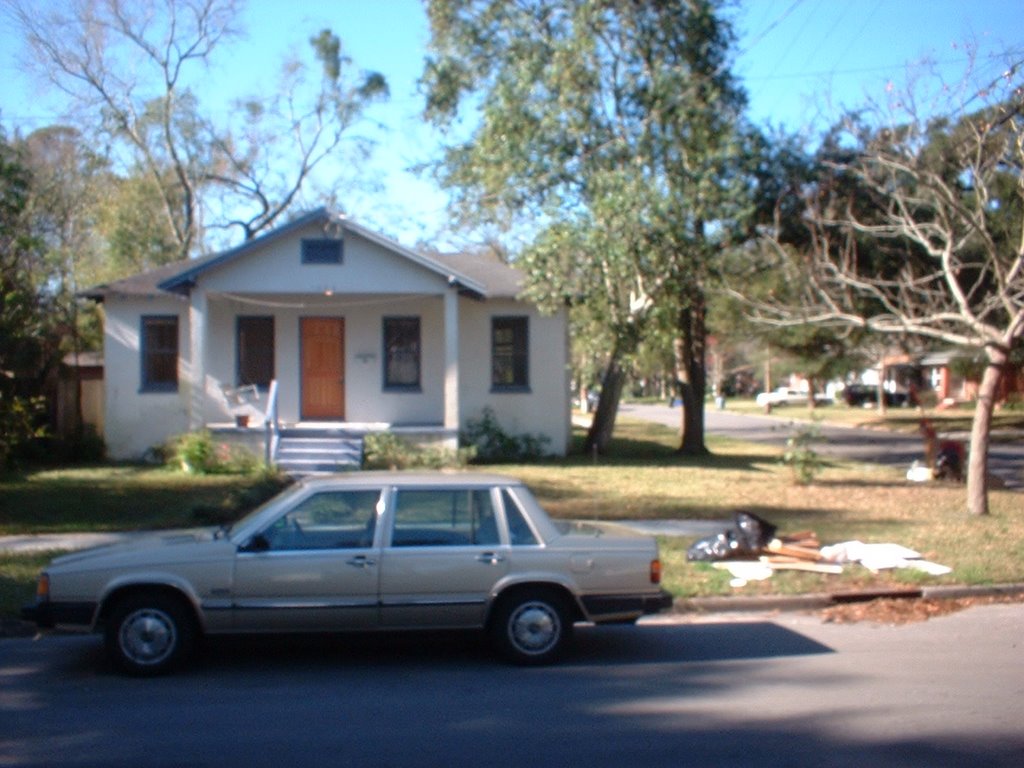
Here is the house (big box) last fall before we bought it. Many species of trees, some dead, so densely packed into the yard.

The small box is the street signpost, a 4' tall obelisk. The street names are long worn away and someday I'm going to stencil them back on.

Archaeology

In the backyard we're going to knock these out and put in an elevated open deck area (obviously not period but popular in Florida) with pergola. The steps are too narrow, a little scary when you're carrying stuff.


Shed location. The lawnmower is now in the dining room. J is measuring the backyard in human scale, like when you see a quarter on an object in a photo. Where he is standing there is a garage foundation that's well entrenched, cinderblock 3 feet deep but no floor. There are driveway ribbons in this photo, buried under 5" of St. Augustine grass and dirt. We've removed most of the scrub trees here in time for hurricane season but the big dark one still leans over our neighbor's house. One mystery is all the plastic and metal tent stakes we've found in the back/side yard.


The POs seem to have had no regard for tree placement and maintenance. Every tree on the lot is growing, whether planted or volunteer, in a strategic location to the power, phone or cable lines, or into the foundation. Two months ago the city came and did its chop job on the ones under power and phone lines, cutting all heck out of one tree. It now looks like a stick with a saucer on top, they left so little of the limbs. Not the tree's fault of course but of the PO who allowed it to start growing there. I'm not sure if the historical ignorance of these trees is what led to the wall crack in the house fixed in the 1970s. The house is actually brick but due to 1. the sand/clay soil or 2. naughty trees a large crack developed in the living room exterior and the house started to separate. The solution was to wrap the entire house in steel mesh, tack it down to the brick, and cover it in cement-type stucco (tho it's not waterproof stucco and the mesh sometimes rusts through). This fix seems to be fine though there is a mess of bricks in the crawl space as one section of the wall was removed. Above the porch the stucco/mesh is the only thing separating the attic from the wide world.
In any case, it's tough to dig anywhere in our yard from the dense network of roots. Glorious trees:


Next on our list:
Paint house
Expand vegetable garden, build elevated beds
Path through yard (front thru gate to back?)
Build shed
Build deck
landscaping of some sort
re-work the kitchen. House was a rental, and poorly maintained. No one realized that the kitchensink/dishwasher greywater was going through the wall and onto the joists instead of out through a pipe. One day I was watering the tomatoes outside the kitchen wall while J was washing dishes and I heard trickling and dripping and called the home warranty people. The rot hole in the joist/wall is big enough to stick my head and a family of rats and a legion of cockroaches through. And also we have cramped cabinetry in the kitchen.

Ralph's Small House


Here at Ralph's House, we're working to renovate a 1928 bungalow-ish house on the outskirts of downtown to the best of our abilities. Currently we're working off a private-school elementary teacher's salary and the know-how of his wife. Lately it's been 96 degrees + outside so our efforts have been limited to peeling 70's wallpaper and cleaning up after the house-flipper's non-code job inside. Before it got hot outside, we installed a fence around our corner lot, the pre-built "french gothic" from Lowes. It's worked moderately well- it used to be whenever we worked in the yard, passers-by would stop to ask us for money. As if.

I'm a purist, which really gets in the way of making decisions. It's as bad as, "if I remove the 1/8" paint buildup on the window frame which cracks further every time I open the window, I am removing this house's history." It bothers me that contemporary ideas about restoration are always changing; I'd like to make a snapshot of the house from 1930. Somewhat not wanting to live in a museum, we need to find the line where period meets modern day function. The original interior paint colors are drab and depressing, and the color combinations, while fascinating to think about in context of their times, are jarring to live with. I guess this is something every restorer has to deal with, and really, it's the journey that's the fun. I think so, anyway.


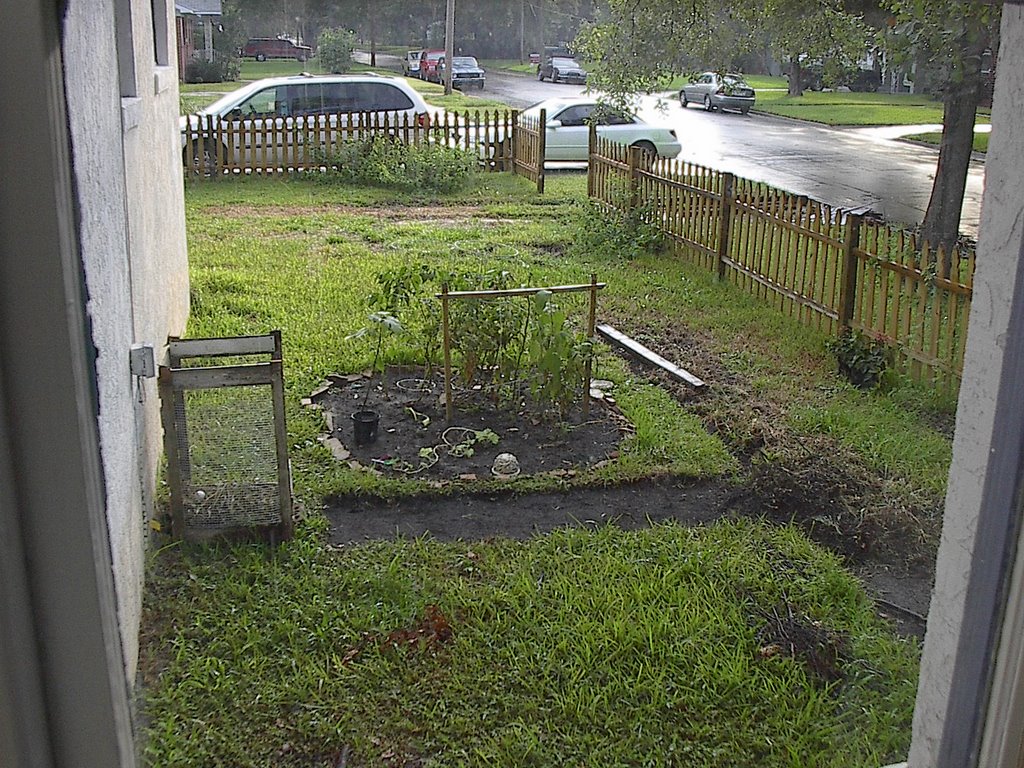
Fence and vegetable garden.


UA-58667865-1